
Long story short: In short, diesel fuel costs less, but diesel bikes are still rare in India. Technical problems, higher costs, and strict rules make them less practical, even though they could save fuel. Here’s why these issues have kept diesel motorcycles from becoming popular.
Diesel motorcycles may look like a smart option for riders in India who want to save money, since diesel fuel costs less than petrol and diesel engines are efficient. However, despite these advantages, diesel bikes are rarely seen on Indian roads.
This article explores the history of diesel motorcycles in India, including why they were introduced, why they faded away, and the technical, economic, and regulatory challenges they faced. We’ll look at why diesel bikes never became common and what their story reveals about changes in Indian transportation.
Key Takeaways
- Diesel motorcycles first appeared in India in the 1980s and gained some popularity in the 1990s. However, they quickly disappeared from the market due to a mix of technical issues, costs, and strict rules.
- Heavier engines, more vibration and noise, and less power compared to petrol motorcycles made diesel motorcycles less attractive to Indian riders who value agility and comfort.
- Higher upfront prices and maintenance costs reduced the savings diesel bikes could offer. This is especially true since petrol motorcycles have become much more fuel-efficient over the years.
- Strict emission standards like the Bharat Stage norm and government efforts to promote greener alternatives made it even harder for diesel bikes to survive. As a result, production stopped and manufacturers were discouraged from developing new diesel models.
- While diesel bikes can save some fuel, they also produce more air pollution, especially particulate matter and nitrogen oxides, making them less suitable for India’s crowded cities.
The Rise And Fall Of Diesel Bikes In India
Diesel motorcycles first appeared in India in the 1980s, became most popular in the early to mid-1990s, and then faded out by the early 2000s. Stricter emission rules and performance issues were the main reasons for their decline.
Origins And Introduction
- Diesel bikes in India started in the 1980s, when street mechanics began fitting Royal Enfield Bullets with diesel engines. These early changes brought diesel-powered motorcycles to the country for the first time.
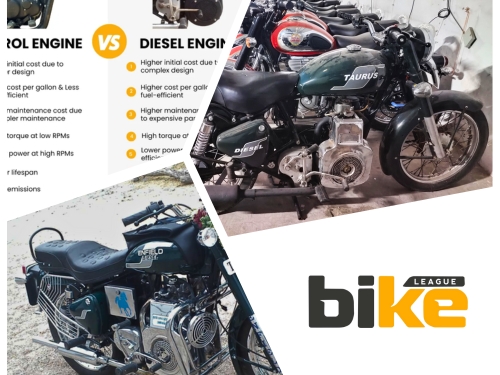
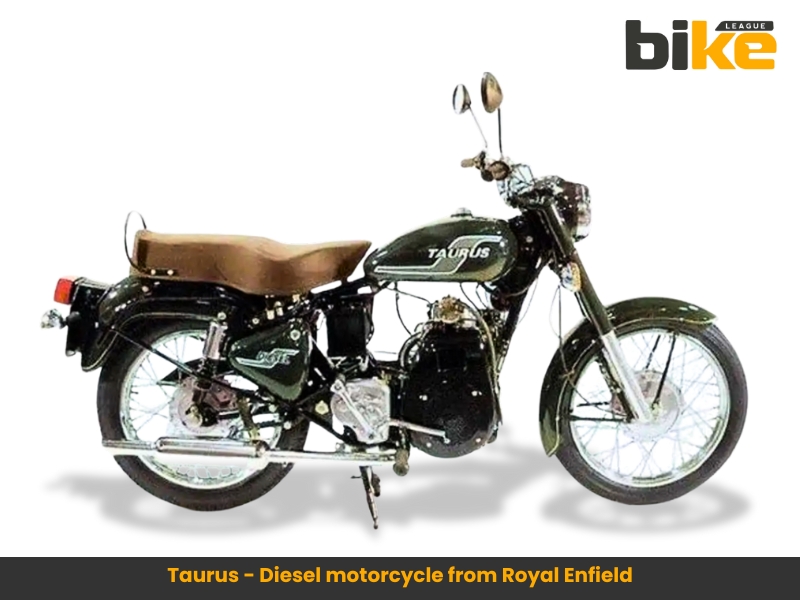
- Seeing how popular these conversions were, Royal Enfield released the Taurus in the early 1990s. The Taurus became India’s only mass-produced diesel motorcycle.
- Besides the Taurus, a few other diesel bikes like the Sooraj Diesel Motorcycle were made in small numbers, primarily for rural and utility-focused riders in the 1990s.
Peak Years Of Popularity
- The Royal Enfield Taurus came with a 325cc diesel engine, offered excellent fuel efficiency (70-85 kmpl), and had low running costs. These features made it popular among rural riders and fleet operators in the 1990s.
- During that period, diesel bikes were also popular with farmers and the military, who used them for border patrol.
Decline And Disappearance
- By the late 1990s and early 2000s, concerns about pollution, noise, vibrations, and poor performance led to a sharp drop in consumer interest in diesel bikes.
- The introduction of stricter Indian emission standards, especially the Bharat Stage norms in 1999, forced manufacturers to stop making both the mass-market Royal Enfield Taurus and other small-batch diesel bikes.
- Taurus production ceased in 2001 due to new rules. After that, diesel bikes mostly disappeared from Indian roads, surviving only as collectibles or in remote areas.
Although diesel is less expensive, you won’t see diesel engines in today’s two-wheelers because of technical issues, higher costs, and strict regulations. These factors make diesel bikes impractical for most motorcycle buyers in India.
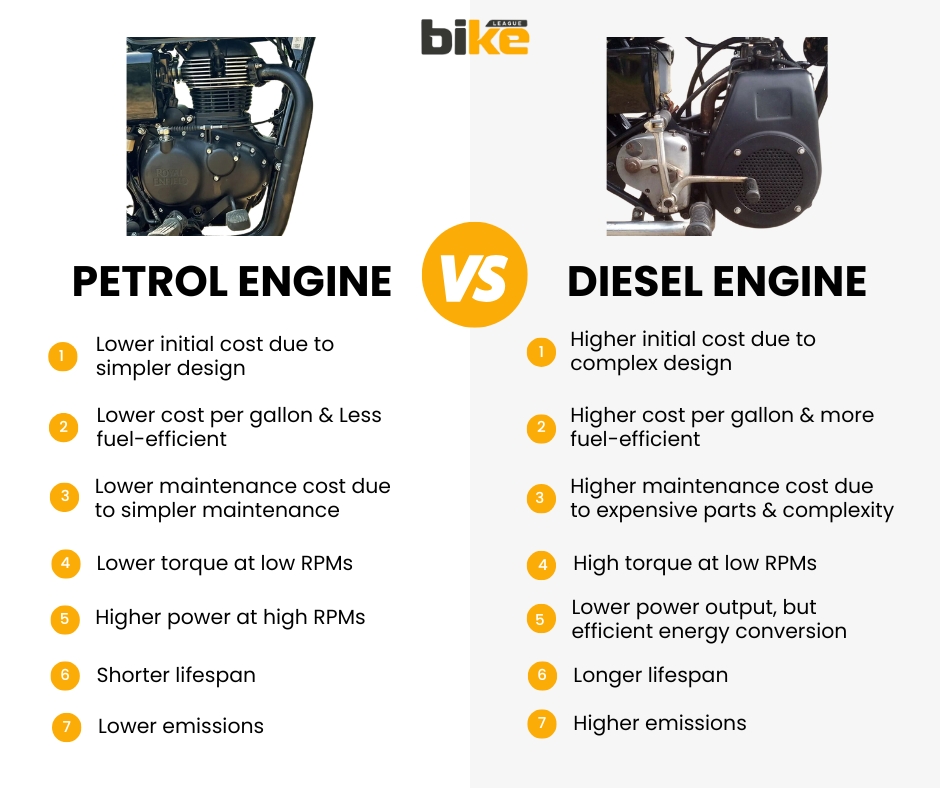
Comparison Of Petrol And Diesel Bike Engines
Here’s a detailed table comparing petrol and diesel motorcycle engines in India.
| Factor | Petrol Engine | Diesel Engine |
|---|---|---|
| Initial cost | Lower — simpler design | Higher — complex design |
| Fuel cost & efficiency | Higher cost per litre, less fuel-efficient | Lower cost per litre, more fuel-efficient |
| Maintenance cost | Lower — simpler maintenance | Higher — expensive parts and added complexity |
| Torque at low RPM | Lower | Higher |
| Power at high RPM | Higher | Lower, but more efficient energy conversion |
| Engine lifespan | Shorter | Longer |
| Emissions | Lower | Higher |
What Are The Technical Challenges, Economic Pressures, And Strict Regulations For Diesel Bikes In India?
1. Technical Challenges
1.1 Engine Weight And Size
Diesel engines are uncommon in Indian bikes because they are heavier and bigger than petrol engines. They require higher compression and stronger parts, which increases their size and weight.
The extra weight makes it harder to design bikes, since lighter bikes handle better and are more efficient. Diesel engines also make bikes less agile, which is a drawback for riders who want quick handling.
1.2 Vibration And Noise
Diesel engines create more vibration and noise, especially at low speeds. This is a problem for bikes where rider comfort matters.
Extra vibrations can make long rides tiring and cause more wear on the bike. The loud diesel sound also isn’t ideal for people who prefer quieter rides.
1.3 Power Delivery And Performance
Diesel engines offer strong torque but usually produce less power than petrol engines of the same size.
This difference in power affects the riding experience, especially for people who use bikes for commuting or for fun.
Petrol engines are popular in India because many riders want quick acceleration and higher top speeds.
2. Economic Factors
2.1 Initial Cost
Diesel bikes are more expensive upfront than petrol bikes. Their complex engines increase manufacturing costs in a market where price matters a lot.
In India, price is a big factor when buying a motorcycle. The higher upfront cost of diesel bikes can put off buyers, even if they might save on fuel later.
2.2 Maintenance Costs
Diesel engines usually require more frequent, more expensive maintenance due to their higher compression and greater wear on parts.
For Indian buyers who are careful with their money, higher maintenance costs can cancel out any savings from cheaper fuel, especially since many city riders don’t travel long distances each year.
2.3 Fuel Efficiency Gains
Diesel engines are more fuel-efficient in larger vehicles, but the benefit is much smaller in motorcycle-sized engines.
The good news is that modern petrol engines in Indian scooters and motorcycles have become much more fuel-efficient, coming close to the efficiency of diesel engines.
As petrol engines improve, there are fewer reasons to pick diesel two-wheelers.
3. Regulatory & Environmental Considerations
3.1 Emission Standards
India introduced stricter emission standards, known as Bharat Stage VI, nationwide from 1 April 2020, following a Ministry of Road Transport and Highways (MoRTH) notification issued in 2016 that directed the country to skip BS-V entirely and leapfrog straight from BS-IV to BS-VI. This helps the environment, but it makes it more problematic for diesel engines, especially on small bikes, to meet the rules.
To meet these new standards, manufacturers have to use advanced technologies such as diesel particulate filters (DPFs) to trap soot and selective catalytic reduction (SCR) systems to reduce harmful nitrogen oxides.
Adding these systems to small bikes can be costly. Because of this, it’s difficult for companies to make diesel bikes that meet strict emission standards and still keep them affordable for everyday riders.
3.2 Government Policies
India encourages cleaner transport, especially electric vehicles and alternative fuels, through policies and incentives. As a result, manufacturers focus less on diesel technology.
These policies discourage manufacturers from investing in diesel two-wheelers.
3.3 Public Perception
Diesel engines are getting more attention because of concerns about air quality in cities. In India’s polluted cities, more people are realizing the health risks linked to diesel.
In short, as India and its riders move toward cleaner, more efficient transport, government policies and public preferences make it difficult for diesel bikes to succeed today.
List Of Diesel Bikes That Were In India
Here’s how the five best-known diesel motorcycles—one Indian mass-production model, one Indian small-batch model, and three imports—compare on the numbers that matter most: power, weight, and what they were actually built to do.
| Model | Manufacturer | Engine | Power | Torque | Top Speed | Kerb Weight | Production |
|---|---|---|---|---|---|---|---|
| Royal Enfield Taurus | Royal Enfield (India) | 325cc single-cylinder, air-cooled diesel | 6.6 PS @ 3,600 rpm | ~15 Nm @ 2,500 rpm | ~65 km/h | 196 kg | 1993–2001 (mass production) |
| Sooraj Diesel Motorcycle | Sooraj Automobiles (India) | 325cc Lombardini/Greaves-Lombardini diesel | ~6.6 PS | Not documented | Not documented | 200 kg | 1990s, small batch |
| Sommer Diesel 462 | Sommer Motorradtechnik (Germany) | 462cc air-cooled diesel (Hatz), Royal Enfield-derived chassis | 11.2 PS @ 3,500 rpm | 26 Nm @ 2,000 rpm | ~99–105 km/h | 165 kg | Hand-built, ongoing; 200+ units to date |
| Track T-800CDI | EVA Products BV (Netherlands) | 800cc turbocharged 3-cylinder diesel (Smart ForTwo-derived) | 45.6 PS @ 3,000 rpm | ~106 Nm | 161–174 km/h (reports vary) | 199–225 kg (reports vary) | ~50 units, 2009–2012 |
| Hayes M1030-M1 (HDT) | Hayes Diversified Technologies (USA) | 584cc water-cooled diesel (Kawasaki KLR650-derived) | ~30.4 PS | ~45 Nm | ~137 km/h | ~177 kg | 2002–2008, ~440 units to USMC |
All five bikes show a clear pattern: diesel motorcycles trade some power for better fuel economy (like the Taurus and Sommer) or more torque for long rides (like the Track T-800CDI). No manufacturer has matched the power-to-weight ratio of petrol engines, which is why none of these diesel bikes went into large-scale production.
How Did Diesel Bikes Have Trouble With Bs Norms, And What Was Their Impact On The Environment In India?
Diesel bikes in India struggled to meet Bharat Stage (BS) emission norms due to technical issues with their engine designs and increasingly stringent environmental rules that came into effect over time.
Compliance Challenges With Bs Norms
- BS norms, set by the Central Pollution Control Board (CPCB) and given legal effect by MoRTH under the Central Motor Vehicles Rules, progressively tightened limits on nitrogen oxides (NOx, gases that contribute to smog), particulate matter (PM, tiny particles that pollute the air), hydrocarbons (HC), and carbon monoxide (CO). Diesel bikes produce higher NOx and particulate emissions, which are harder to control without complex, expensive after-treatment technologies such as Diesel Particulate Filters (DPFs), which trap soot from the exhaust.
- Indian diesel two-wheelers were subject to the same emission standards as diesel three-wheelers, but meeting these standards was challenging due to the two-wheeler’s size and cost constraints on adopting advanced pollution-control technologies.
- The jump from Bharat Stage IV to Bharat Stage VI standards imposed dramatically lower emission limits, especially for NOx (nitrogen oxides) and PM (particulate matter), requiring technology that diesel bike manufacturers found difficult to incorporate economically.
- As a result, the last mass-produced diesel bike, the Royal Enfield Taurus, was discontinued around 2001 because it failed to comply with the new BS standards. No significant new diesel bike models were introduced thereafter.
Environmental Impact Of Diesel Bikes In India
- Diesel engines emit significantly higher levels of particulate matter and NOx than petrol engines of comparable size, which are major contributors to urban air pollution, smog, and respiratory health issues.
- Two-wheelers are a measurable contributor to particulate pollution in the National Capital Region: a 2024 Commission for Air Quality Management (CAQM) source-apportionment revisit found two-wheelers account for around 31% of PM2.5 and PM10 in the NCR, second only to road dust as a category. Diesel-powered two-wheelers would sit within this share, though CAQM’s data does not break the figure down by fuel type.
- Due to pollution concerns, India’s vehicle emission regulations have progressively tightened since 2000 (BS-I) through to BS-VI in 2020, with diesel-specific after-treatment requirements (DPF, SCR) becoming mandatory across categories, making compliance economically unviable for small-displacement diesel bikes specifically.
What’s Replacing The Diesel Bike’s Value Proposition In 2026?
Diesel motorcycles disappeared because they couldn’t offer low running costs without the extra weight, noise, and emissions that came with them. The demand for cheap daily transport remains, and Indian manufacturers are now meeting it in three ways.
Flex-fuel Motorcycles
TVS introduced India’s first ethanol-compatible motorcycle, the Apache RTR 200 Fi E100, back in 2019. That trickle has turned into a real product category through 2025–26:
- Honda CB300F Flex Fuel
- Suzuki Gixxer SF 250 FFV
- Yamaha FZ Blue Flex
are all commercially available and run on blends from E20 to E85. Hero MotoCorp brought flex-fuel to its most popular commuter segment in June 2026 with the Splendor+ and HF Deluxe Flex Fuel models, and TVS has confirmed a Raider 125 Flex Fuel is coming later in 2026.
The idea is familiar: ethanol is made in India and costs less than petrol. Unlike diesel, flex-fuel engines are just an adaptation of existing petrol engines, so manufacturers can add them to current models without designing something completely new.
Cng Motorcycles
Bajaj took a different approach with the
Launched in 2024 as the world’s first mass-produced CNG motorcycle. It uses a dual-fuel system with a factory-fitted CNG cylinder and a small backup petrol tank.
Bajaj says running costs are up to 50% lower than those of a similar petrol commuter, with mileage of around 90–100 km per kg. This echoes the diesel bike’s original promise of cheap fuel and low running costs, but uses a different approach and relies on India’s well-established CNG infrastructure used by three-wheelers and city buses.
Electric And Hydrogen
Electric two-wheelers remain the dominant alternative-powertrain story in India, backed by sustained government incentives, though adoption in the motorcycle segment specifically (as opposed to scooters) has been slower than in four-wheelers.
Further out, Japan’s four major motorcycle manufacturers — including Kawasaki, which unveiled a hydrogen-fuelled prototype based on its supercharged Ninja H2 in 2024 — are jointly developing hydrogen combustion engines for motorcycles. Nothing at that stage is close to the Indian market yet, but it signals where the technology conversation is heading once battery-electric two-wheelers hit their own limits.
None of these options fully match what diesel offered. None combine diesel’s low fuel cost and long-range efficiency in a two-wheeler. But each one addresses the same problem diesel tried to solve in the 1990s: keeping running costs low as fuel prices rise.
Faq Related To Diesel Bikes In India
1. Why Aren’t Diesel Engines Used In Bikes In India Despite Cheaper Fuel Costs?
Even though diesel prices are lower, the technical challenges, higher upfront costs, and regulatory hurdles make it challenging for bikes in India to truly benefit from the potential fuel savings.
2. What Are The Main Technical Challenges Of Using Diesel Engines In Motorcycles?
There are several technical challenges when using diesel engines in small, agile bikes. These include heavier engines, more vibration and noise, extra heat, and lower performance at low speeds. These issues make the topic interesting to explore.
3. How Do Emission Regulations Affect The Use Of Diesel Engines In Bikes?
Bharat Stage VI norms, in force nationwide since April 2020, make it quite challenging to fit the necessary emission-control technologies, such as DPF and SCR, into bikes’ limited space. See our BS norms compliance section for the full regulatory timeline.
4. Are Diesel Motorcycles More Fuel-efficient Than Petrol Ones?
Diesel engines are known for being fuel-efficient, but on smaller bikes, the benefits are less noticeable. The cost savings may not be as significant for these smaller engines.
5. What Are The Cost Implications Of Producing Diesel Bikes?
Building diesel bikes usually costs more because they require stronger components, advanced fuel injection, and specialized emission-control technology. This makes them more expensive in India’s price-sensitive market.
6. How Do Diesel Engines Affect The Performance Of Bikes?
Diesel engines deliver strong torque but typically produce less power and may not perform as well at higher speeds as petrol engines. This makes petrol engines a better choice for riders who want a more exciting ride.
7. What Are The Environmental Concerns Related To Diesel Bikes?
Diesel engines release more particulate matter and nitrogen oxides than petrol engines of similar size. Two-wheelers as a category are a measurable contributor to PM2.5 in Indian cities — see our environmental impact section for the CAQM data on this.
8. How Do Maintenance Costs Compare Between Diesel And Petrol Bikes?
Diesel engines require more regular maintenance and can be pricier. This is because they operate at higher compression ratios and fuel pressures, which can cause greater wear on parts.
9. Are There Any Successful Examples Of Diesel Motorcycles In India?
Yes — the Royal Enfield Taurus is the clearest success story: it remained in mass production for eight years (1993–2001), delivered a claimed 70–86 kmpl, and stands as the world’s only mass-produced diesel motorcycle. Royal Enfield also supplied diesel models to farmers and military units during this period. Its production run ultimately ended not because it failed commercially, but because it couldn’t meet the emission standards introduced from 1999 onward.
10. Why Are Manufacturers Not Investing In Diesel Technology For Bikes In India?
Manufacturers are focusing more on cleaner technologies, such as electric vehicles, especially with government incentives. People’s preferences are changing, and uncertainty about diesel technology is growing due to new environmental policies. This is driving more innovation and a push toward sustainability.
11. Can I Legally Register And Ride An Old Diesel Bike Like The Taurus In India Today?
It’s complicated and depends heavily on the vehicle’s age and where you plan to ride it. MoRTH’s 2021 amendment to the Central Motor Vehicles Rules created a “vintage motor vehicle” category for two-wheelers over 50 years old that are unmodified and used non-commercially — but a 1990s-era Taurus or Sooraj won’t qualify for this until the 2040s, so it currently falls under standard registration renewal rules rather than the vintage exemption.
In Delhi-NCR specifically, the Supreme Court and National Green Tribunal have restricted diesel vehicles older than 10 years from being driven or re-registered at all, which would already apply to any surviving diesel Taurus. Outside NCR, rules vary by state RTO, and getting a valid Pollution Under Control certificate for an old diesel engine can be difficult given current emission limits. If you’re looking to buy or register one, check with your state RTO directly rather than relying on a general answer — see our pollution certificate guide for the PUC side of this.
Other Related Articles From Bikeleague India
- Diesel Wash For Bike: Is It Good or Bad
- Bike wash – Different types, procedures, precautions, FAQ
- Different types of motorcycles explained
- Motorcycle engine – Understanding the different types
- Bike Pollution Certificate – Key to Legal & Eco-Friendly Riding
Conclusion
The story of diesel motorcycles in India shows how real-world challenges can shape and limit new technology. Even though diesel bikes were once touted as fuel-efficient, they were eventually replaced by better petrol engines, stricter rules, and a shift toward cleaner transportation.
Today, as India moves toward more sustainable and electric vehicles, diesel motorcycles remain an interesting part of the country’s automotive history. They remind us that the best solution isn’t always the most obvious one.
If you have questions or want more information, feel free to email us at bikeleagueindia@gmail.com or leave a comment below. We’re always happy to help. You can also follow Bikeleague India on social media to stay updated.

Sir i am a bike lover & one of a reader of your article .How can we get an fully authorized deiseal bullet . an get permission to drive all over the India .
Diesel bullet is a thing of past and as you know there are lot of emission issues related to the same and will be an issue to drive with the same all over India.